Wow this is an abbreviated list of the "essential" DS9 episodes.
Showing posts with label Star Trek. Show all posts
Showing posts with label Star Trek. Show all posts
Tuesday, February 9, 2021

Sunday, July 31, 2016
Star Trek Beyond review
The Return of the King and Revenge of the Sith are the only "Part Three" films that particularly shine (and Revenge arguably only shines in comparison to its predecessors) - unless you count Goldfinger, of course.
Star Trek Beyond is the 13th Star Trek film and the third in the rebooted film franchise. It is more Goldfinger than Return of the King, in that it's not wrapping up a trilogy or anything, it's Just Another Star Trek Film. There are a few things in it that seem really dumb or contrived that later turn out to actually be bits of foreshadowing, but that doesn't change the fact that they seem dumb or contrived when they're introduced (and one in particular that causes a massive plot hole when the "foreshadowing" penny drops). The Badass Alien Chick Who Barely Understands Humans is hands-down the best part of the film. Give her her own film please. You know you're going to do that stupid "cinematic universe" thing to compete with Marvel's Underpants Brigade and Mickey's Jedi Fanfic, so seriously make a movie about Albino Alien Katniss.
(Her name's "Jaylah," as in J-Law, because guess whose characters they based her on?)
So here's the part of the plot that the trailers spoiled: the Enterprise is destroyed and Kirk and company are stranded on a planet with an evil alien warlord played by Idris Elba. They have to use their wits to survive and save the day blah blah blah.
Now, I bitched and moaned back in my Skyfall review about how it would be nice to actually f*cking wound James Bond for once and make him rely on his wits to survive and save the day blah blah blah, so I was kind of interested in seeing how this would work.
It works all right, I guess. There were a couple of instances where the exposition felt really rushed, as if they just wanted to get to the Big Dumb Action without really explaining why the Big Dumb Action was necessary. The fight scenes were also poorly edited, which seems to be an ongoing problem in Hollywood for almost everyone who isn't the Russo Brothers. There's some great by-play between Spock and McCoy (Karl Urban remains hands-down the best cast member, convincing me effortlessly that he's a young DeForest Kelley). There are a lot of neat little references to classic Trek - my favorite is a photo of the original cast (i.e., Shatner et al.) among Old Spock's belongings, which is obviously* a cast photo from The Undiscovered Country - and the score very subtly quotes the Undiscovered Country theme right as it's shown. They worked Leonard Nimoy's death into the plot, which is touching, but that's counterbalanced by some really awkward stuff involving Chekov (for those who don't know, Anton Yelchin, who plays Chekov in the rebooted film series, died in a freak car accident a month before the film premiered). There's some appallingly bad CGI involving a motorcycle, and the film has about three separate climaxes. Oh, and you can totally see the join between Idris Elba's lips and his (otherwise very impressive) mask. Overall I'd give the film a B+, which puts it light-years ahead of Star Trek: The Wrath of Sherlock.
*TvTropes seems to think it's a cast photo for The Final Frontier, but the Enterprise bridge set doesn't match that film. YES I AM A NERD.
SPOILERS BELOW
Star Trek Beyond is the 13th Star Trek film and the third in the rebooted film franchise. It is more Goldfinger than Return of the King, in that it's not wrapping up a trilogy or anything, it's Just Another Star Trek Film. There are a few things in it that seem really dumb or contrived that later turn out to actually be bits of foreshadowing, but that doesn't change the fact that they seem dumb or contrived when they're introduced (and one in particular that causes a massive plot hole when the "foreshadowing" penny drops). The Badass Alien Chick Who Barely Understands Humans is hands-down the best part of the film. Give her her own film please. You know you're going to do that stupid "cinematic universe" thing to compete with Marvel's Underpants Brigade and Mickey's Jedi Fanfic, so seriously make a movie about Albino Alien Katniss.
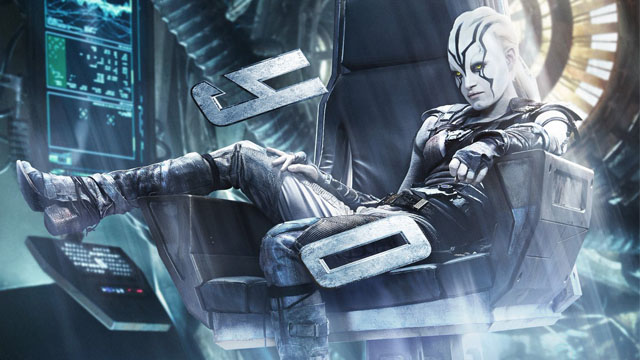 |
| Yes, you may marry me. |
So here's the part of the plot that the trailers spoiled: the Enterprise is destroyed and Kirk and company are stranded on a planet with an evil alien warlord played by Idris Elba. They have to use their wits to survive and save the day blah blah blah.
Now, I bitched and moaned back in my Skyfall review about how it would be nice to actually f*cking wound James Bond for once and make him rely on his wits to survive and save the day blah blah blah, so I was kind of interested in seeing how this would work.
It works all right, I guess. There were a couple of instances where the exposition felt really rushed, as if they just wanted to get to the Big Dumb Action without really explaining why the Big Dumb Action was necessary. The fight scenes were also poorly edited, which seems to be an ongoing problem in Hollywood for almost everyone who isn't the Russo Brothers. There's some great by-play between Spock and McCoy (Karl Urban remains hands-down the best cast member, convincing me effortlessly that he's a young DeForest Kelley). There are a lot of neat little references to classic Trek - my favorite is a photo of the original cast (i.e., Shatner et al.) among Old Spock's belongings, which is obviously* a cast photo from The Undiscovered Country - and the score very subtly quotes the Undiscovered Country theme right as it's shown. They worked Leonard Nimoy's death into the plot, which is touching, but that's counterbalanced by some really awkward stuff involving Chekov (for those who don't know, Anton Yelchin, who plays Chekov in the rebooted film series, died in a freak car accident a month before the film premiered). There's some appallingly bad CGI involving a motorcycle, and the film has about three separate climaxes. Oh, and you can totally see the join between Idris Elba's lips and his (otherwise very impressive) mask. Overall I'd give the film a B+, which puts it light-years ahead of Star Trek: The Wrath of Sherlock.
*TvTropes seems to think it's a cast photo for The Final Frontier, but the Enterprise bridge set doesn't match that film. YES I AM A NERD.
SPOILERS BELOW
Friday, February 27, 2015
...his was the most... human.
There's a rumor, I honestly don't know how true it is, that goes like this:
The "Kobayashi Maru" scenario at the beginning of The Wrath of Khan was thrown in there because Leonard Nimoy, who played Spock, wanted to quit the franchise, and word had gotten out that Spock was going to be killed off. So the scenario was thrown in at the beginning of the film, fake-out killed not only Spock but the entire crew, and (apparently) threw movie-goers off the scent.
I don't believe that story. Or, rather, if that story is true, then it certainly wasn't done at the last minute. The Kobayashi Maru is essential to all the goodness of The Wrath of Khan. Kirk is this space-cowboy character who laughs in the face of danger because he, as Saavik tells him at one point, has never actually faced death. Kirk cheated on the KM test, survived the Original Series on luck and balls (see, e.g., "The Corbomite Maneuver"), and thought he was invincible. By having the KM test, the film can incorporate the fact that Kirk cheated - has never faced the no-win scenario, ever. He straight-up says he doesn't believe in it. Even when he's in the Genesis Cave right before the final battle, Kirk still thinks he can simply outsmart Khan again.
He can't.
He got lucky with the computer codes during their initial encounter. But it's Spock's idea to run to the Mutara Nebula. It's Spock's observation that Khan has mistook space for an ocean and is just operating in two dimensions. And it is, of course, Spock who sacrifices himself at the end.
The Wrath of Khan is so great because it shows never-grow-up Kirk* coming face-to-face with mortality, both in the "midlife crisis" subtext running throughout the film, and in Spock's death at the end. Cut out the references to the Kobayashi Maru, the no-win scenario, and all of that is cheapened.
*Let's not forget that Kirk's final line in The Undiscovered Country - and therefore in the entirety of the Original Series adventures - is a quote from Peter Pan.
So as I said, I don't believe that story.
The Wrath of Khan is one of my favorite movies ever. One of the things that's particularly (sorry) fascinating about it is that even though it's Kirk who has/suffers all the character development/deconstruction over the course of the film, Spock is the film's actual hero. (Another think I like, not particularly pertinent to this post, is that because they thought it was going to be the last one, they were willing to do two things they'd never done before: damage the Enterprise model, and kill off a major character.)
Leonard Nimoy, 1931-2015
He lived long, and he prospered.
The "Kobayashi Maru" scenario at the beginning of The Wrath of Khan was thrown in there because Leonard Nimoy, who played Spock, wanted to quit the franchise, and word had gotten out that Spock was going to be killed off. So the scenario was thrown in at the beginning of the film, fake-out killed not only Spock but the entire crew, and (apparently) threw movie-goers off the scent.
I don't believe that story. Or, rather, if that story is true, then it certainly wasn't done at the last minute. The Kobayashi Maru is essential to all the goodness of The Wrath of Khan. Kirk is this space-cowboy character who laughs in the face of danger because he, as Saavik tells him at one point, has never actually faced death. Kirk cheated on the KM test, survived the Original Series on luck and balls (see, e.g., "The Corbomite Maneuver"), and thought he was invincible. By having the KM test, the film can incorporate the fact that Kirk cheated - has never faced the no-win scenario, ever. He straight-up says he doesn't believe in it. Even when he's in the Genesis Cave right before the final battle, Kirk still thinks he can simply outsmart Khan again.
He can't.
He got lucky with the computer codes during their initial encounter. But it's Spock's idea to run to the Mutara Nebula. It's Spock's observation that Khan has mistook space for an ocean and is just operating in two dimensions. And it is, of course, Spock who sacrifices himself at the end.
The Wrath of Khan is so great because it shows never-grow-up Kirk* coming face-to-face with mortality, both in the "midlife crisis" subtext running throughout the film, and in Spock's death at the end. Cut out the references to the Kobayashi Maru, the no-win scenario, and all of that is cheapened.
*Let's not forget that Kirk's final line in The Undiscovered Country - and therefore in the entirety of the Original Series adventures - is a quote from Peter Pan.
So as I said, I don't believe that story.
The Wrath of Khan is one of my favorite movies ever. One of the things that's particularly (sorry) fascinating about it is that even though it's Kirk who has/suffers all the character development/deconstruction over the course of the film, Spock is the film's actual hero. (Another think I like, not particularly pertinent to this post, is that because they thought it was going to be the last one, they were willing to do two things they'd never done before: damage the Enterprise model, and kill off a major character.)
Leonard Nimoy, 1931-2015
He lived long, and he prospered.
Monday, June 10, 2013
Rant of the day: Episode Rankings
Buzzfeed has done a list ranking the Game of Thrones episodes from best to worst. Go check it out. I don't specifically disagree with any one thing, but...
This is like if I went through and ranked my favorite chapters of the books. ("Oh, man, Dance with Dragons chapter 59 got me excited about the plot for the first time in 500 pages!")
It's because you're telling one massive story. You can go through and rank Star Trek episodes, even the later Deep Space 9 ones. You can even do it to Bablyon 5 and Battlestar Galactica because each episode does tend to have one or two focuses while still advancing the overall story. But with Game of Thrones, you're always advancing everyone's story in five-minute chunks every episode. With one exception. But there's never a Jon-specific episode or a Daenerys-specific episode.
So to me, picking and choosing your favorite Game of Thrones episode is like saying "I liked how everyone's plot was handled in this specific week more than any other week" rather than "that episode had good story, solid character development, emotional impact, etc." Which is not to say that Thrones doesn't have those things, but I just can't judge an episode based on how it tells five minutes' worth of ten different story.
This is like if I went through and ranked my favorite chapters of the books. ("Oh, man, Dance with Dragons chapter 59 got me excited about the plot for the first time in 500 pages!")
It's because you're telling one massive story. You can go through and rank Star Trek episodes, even the later Deep Space 9 ones. You can even do it to Bablyon 5 and Battlestar Galactica because each episode does tend to have one or two focuses while still advancing the overall story. But with Game of Thrones, you're always advancing everyone's story in five-minute chunks every episode. With one exception. But there's never a Jon-specific episode or a Daenerys-specific episode.
So to me, picking and choosing your favorite Game of Thrones episode is like saying "I liked how everyone's plot was handled in this specific week more than any other week" rather than "that episode had good story, solid character development, emotional impact, etc." Which is not to say that Thrones doesn't have those things, but I just can't judge an episode based on how it tells five minutes' worth of ten different story.
Thursday, May 23, 2013
Star Trek Into Darkness
To create Star Trek Into Darkness: Take five parts Star Trek II, four parts Star Trek VI, one part Babylon 5, one part Blade Runner, and one part Battlestar Galactica. Stir randomly until the vaguest sense of originality appears, and fling on the screen.
Sunday, February 3, 2013
Apropos nothing at all
I present you with the overture to Star Trek VI: The Undiscovered Country.
Horribly underrated, both the film and the score.
Horribly underrated, both the film and the score.
Monday, June 4, 2012
The innovation that broke the camel's back
The idea for this post originated with something Mike Stoklasa once said. If that name's not familiar, try "Mr. Plinkett." If that name's not familiar, go to RedLetterMedia.com right now, do not pass Go, do not collect $200,000.
In his review of Star Trek (2009), he mentions that the Dominion War arc on Deep Space Nine broke the modern (24th-century) Trek franchise. Now, as a diehard Niner I found myself in the very rare position of disagreeing with Plinkett. The point of the Dominion War arc was to stretch Gene Roddenberry's bright shiny brave new world to its breaking point. I direct you to the episode "In the Pale Moonlight," in which Sisko sells out the Federation's principles in order to save it.
This is not "breaking a franchise." This is merely deconstructing it. Plinkett argues that after the Dominion War, there was no way to raise the stakes even more, but that was kind of the point of the Dominion War in the first place. After Deep Space and Voyager wrapped, the franchise owners had two options. They could have another 24th-century show set in the aftermath of the Dominion War, but that would have been too close to the original premise of Deep Space - you know, the Federation kinda-sorta helping a war-torn civilization get back on its feet - to really let it stand apart.
The other option was to abandon the 24th century and go somewhere else. This is what they did, but they decided to do a prequel and the result sucked. I think that move killed the franchise a lot more than the Dominion War ever did.
Now, I saw the Plinkett reviews a while ago, so why am I only coming to this now? Because there was an article about the Nintendo Wii U that caught my eye.
See, innovation is key to any business plan. Deep Space started out as a thinly disguised copy of Babylon Five, but it really came into its own (and started laying the groundwork for That Other Show) once the Dominion War started. Voyager at least managed to be different from NextGen. Enterprise was just... well, NextGen with less tech, and supposedly less continuity to worry about, both of which were solutions to legitimate problems that cropped up repeatedly in NextGen and Deep Space. It's just that those solutions didn't work, Enterprise had its own set of problems, mostly related to the fact that it was never very good, etc etc.
Now over to the Wii. In my own humble opinion, the greatest video games of the last decade or so have been Half-Life 2, Portal, and the three Mass Effect games. I'll also mention Assassin's Creed and StarCraft II because I've gotten a lot of playtime out of both of them. Now you know what all seven of those games have in common? None of them are available for the Wii.
There are games for the Wii and its predecessor that are good. Don't get me wrong. There are Nintendo console games that are great. F-Zero GX will forever be the greatest racing game of all time (let's face it, steering with a keyboard sucks). Zelda has re-made the same game at least four times now. Super Mario Galaxy was a great step forward for that stale platformer. Super Smash Brothers is pretty much a mainstay ever since the 64 days.
But here's the thing. Nintendo substituted innovation in its games for innovation in its console design. The result is every fanboy can use a lightsaber, but you're SOL if you want a good shooter. Or an original story. Every single one of the "greatest video games of the last decade or so" I mentioned above is part of a franchise, but in a different sense than the Nintendo games. Mass Effect 3 does not have the exact same story as the original Mass Effect (well, aside from the part where the plots revolve around an ancient artifact that starts with the letter C but isn't a weapon or originally built by the Protheans like everyone thought, the games end with a mad dash towards a Conduit followed by a scene where you can get the big bad to shoot himself...)
See what I did there? I nitpicked. But every Mario game since time began has had the exact same plot: Bowser has the princess and the plumber needs to save her. Every Smash Brothers game is just the Nintendo all-stars beating each other up because they've gotten bored playing board games or golf or tennis or go-karts. The Zelda games play with the formula a bit, but it's generally true that Link and Zelda are involved, and that Ganon(dorf) is Up To Something.
The Point of No Return
Where Plinkett was right about the Dominion War arc was that it was a point of no return. Once the Dominion came screaming through the wormhole, pretty much every episode had to address it, and when they didn't, when the crew dropped everything to screw around in the holosuite, the show lagged. Gone was the peaceful future where every single problem known to man had been resolved. (In terms of drama, this was a very good thing. One of the main reasons I'm a Niner in the first place is because too much TNG is stale, boring and preachy.) But once the Dominion War started, there were simply things the show couldn't do anymore.
Same thing with the Wii. Once Nintendo introduced their motion-control lightsaber stick, they'd passed their own point of no return. To go back to a traditional console controller would be to admit defeat. But the problem is, outside developers aren't going to waste the time to make two different versions of every game. In the past, porting games from one console to another (or from consoles to the PC) was fairly straightforward. You just mapped everything to a different button. Now instead of a console-PC divide, you have a Nintento-and-everything-else divide (again, note that Mass Effect 2 and 3 came out on every system except Nintendo's).
Now when you pass the point of no return, you generally - not always - find yourself closing more doors than you opened. You get jerkass consumers like me who would rather fight mecha-Cthulhu (and frak a rock-faced bird-thing) than swing a fake lightsaber around, which is why I own the Mass Effect games and not the Force Unleashed games. You lose outside talent. Portal, as Yahtzee said, has one of the highest meme-to-content ratios, but it also has one of the highest sucess-to-cost ratios. Opening the Mass Effect series up to the PS3 brought in a huge stream of revenue. But you can't do that with Nintendo because they've decided that "innovation" is more important than processing power.
Now to get to the meat. The video game industry is based almost entirely on Medal of Duty: Call of Honor and every other game just like it. There are enough people out there, with sufficiently large wallets, to choke down round after round of stale WWII shooters, but they're the ones who help pay the costs of making games like Mass Effect.
To drag this back into television terms, it's like having a massive story arc that slowly bleeds viewers. Eventually, you have to dumb things down and do some standalones to try to bring in new viewers and let them catch up. It makes the fans upset, but it's a necessary evil. (See the episodes 14-16 of BSG Season 3 for a prime example of this.)
I've strayed really far off topic and covered an absurd amount of ground here. "People are a problem" is what I'm trying to say. You need to plan your innovations carefully, because they are massive, massive risks. You're probably better off not taking risks. But when you do, and your audience likes them, the payoffs can be massive.
In his review of Star Trek (2009), he mentions that the Dominion War arc on Deep Space Nine broke the modern (24th-century) Trek franchise. Now, as a diehard Niner I found myself in the very rare position of disagreeing with Plinkett. The point of the Dominion War arc was to stretch Gene Roddenberry's bright shiny brave new world to its breaking point. I direct you to the episode "In the Pale Moonlight," in which Sisko sells out the Federation's principles in order to save it.
This is not "breaking a franchise." This is merely deconstructing it. Plinkett argues that after the Dominion War, there was no way to raise the stakes even more, but that was kind of the point of the Dominion War in the first place. After Deep Space and Voyager wrapped, the franchise owners had two options. They could have another 24th-century show set in the aftermath of the Dominion War, but that would have been too close to the original premise of Deep Space - you know, the Federation kinda-sorta helping a war-torn civilization get back on its feet - to really let it stand apart.
The other option was to abandon the 24th century and go somewhere else. This is what they did, but they decided to do a prequel and the result sucked. I think that move killed the franchise a lot more than the Dominion War ever did.
Now, I saw the Plinkett reviews a while ago, so why am I only coming to this now? Because there was an article about the Nintendo Wii U that caught my eye.
See, innovation is key to any business plan. Deep Space started out as a thinly disguised copy of Babylon Five, but it really came into its own (and started laying the groundwork for That Other Show) once the Dominion War started. Voyager at least managed to be different from NextGen. Enterprise was just... well, NextGen with less tech, and supposedly less continuity to worry about, both of which were solutions to legitimate problems that cropped up repeatedly in NextGen and Deep Space. It's just that those solutions didn't work, Enterprise had its own set of problems, mostly related to the fact that it was never very good, etc etc.
Now over to the Wii. In my own humble opinion, the greatest video games of the last decade or so have been Half-Life 2, Portal, and the three Mass Effect games. I'll also mention Assassin's Creed and StarCraft II because I've gotten a lot of playtime out of both of them. Now you know what all seven of those games have in common? None of them are available for the Wii.
There are games for the Wii and its predecessor that are good. Don't get me wrong. There are Nintendo console games that are great. F-Zero GX will forever be the greatest racing game of all time (let's face it, steering with a keyboard sucks). Zelda has re-made the same game at least four times now. Super Mario Galaxy was a great step forward for that stale platformer. Super Smash Brothers is pretty much a mainstay ever since the 64 days.
But here's the thing. Nintendo substituted innovation in its games for innovation in its console design. The result is every fanboy can use a lightsaber, but you're SOL if you want a good shooter. Or an original story. Every single one of the "greatest video games of the last decade or so" I mentioned above is part of a franchise, but in a different sense than the Nintendo games. Mass Effect 3 does not have the exact same story as the original Mass Effect (well, aside from the part where the plots revolve around an ancient artifact that starts with the letter C but isn't a weapon or originally built by the Protheans like everyone thought, the games end with a mad dash towards a Conduit followed by a scene where you can get the big bad to shoot himself...)
See what I did there? I nitpicked. But every Mario game since time began has had the exact same plot: Bowser has the princess and the plumber needs to save her. Every Smash Brothers game is just the Nintendo all-stars beating each other up because they've gotten bored playing board games or golf or tennis or go-karts. The Zelda games play with the formula a bit, but it's generally true that Link and Zelda are involved, and that Ganon(dorf) is Up To Something.
The Point of No Return
Where Plinkett was right about the Dominion War arc was that it was a point of no return. Once the Dominion came screaming through the wormhole, pretty much every episode had to address it, and when they didn't, when the crew dropped everything to screw around in the holosuite, the show lagged. Gone was the peaceful future where every single problem known to man had been resolved. (In terms of drama, this was a very good thing. One of the main reasons I'm a Niner in the first place is because too much TNG is stale, boring and preachy.) But once the Dominion War started, there were simply things the show couldn't do anymore.
Same thing with the Wii. Once Nintendo introduced their motion-control lightsaber stick, they'd passed their own point of no return. To go back to a traditional console controller would be to admit defeat. But the problem is, outside developers aren't going to waste the time to make two different versions of every game. In the past, porting games from one console to another (or from consoles to the PC) was fairly straightforward. You just mapped everything to a different button. Now instead of a console-PC divide, you have a Nintento-and-everything-else divide (again, note that Mass Effect 2 and 3 came out on every system except Nintendo's).
Now when you pass the point of no return, you generally - not always - find yourself closing more doors than you opened. You get jerkass consumers like me who would rather fight mecha-Cthulhu (and frak a rock-faced bird-thing) than swing a fake lightsaber around, which is why I own the Mass Effect games and not the Force Unleashed games. You lose outside talent. Portal, as Yahtzee said, has one of the highest meme-to-content ratios, but it also has one of the highest sucess-to-cost ratios. Opening the Mass Effect series up to the PS3 brought in a huge stream of revenue. But you can't do that with Nintendo because they've decided that "innovation" is more important than processing power.
Now to get to the meat. The video game industry is based almost entirely on Medal of Duty: Call of Honor and every other game just like it. There are enough people out there, with sufficiently large wallets, to choke down round after round of stale WWII shooters, but they're the ones who help pay the costs of making games like Mass Effect.
To drag this back into television terms, it's like having a massive story arc that slowly bleeds viewers. Eventually, you have to dumb things down and do some standalones to try to bring in new viewers and let them catch up. It makes the fans upset, but it's a necessary evil. (See the episodes 14-16 of BSG Season 3 for a prime example of this.)
I've strayed really far off topic and covered an absurd amount of ground here. "People are a problem" is what I'm trying to say. You need to plan your innovations carefully, because they are massive, massive risks. You're probably better off not taking risks. But when you do, and your audience likes them, the payoffs can be massive.
Monday, January 23, 2012
The top 5 most undignified, anticlimatic deaths in science fiction
SPOILERS AHEAD
Dishonorable mentions:
Kara "Starbuck" Thrace (2nd time) and the Fourth Doctor. But this list is already overdosed with crappy Doctor deaths, and Starbuck at least got a very moving (if slightly unbelievable) death scene the first time she died. (As much as I revere Ron Moore, he's responsible for two deaths that make the list in addition to Starbuck's dishonorable mention. Ouch. On the plus side, he's also got an honorable mention and a solid entry on the "good death" list.)
5) Sam Anders
I know this one is going to be controversial. Or at least it would if anyone read this blog. I love Battlestar Galactica as much as the next nerd, but this was painful to watch.
It wasn't the death itself (which occurs just offscreen, as the most beautiful rendition of the original Battlestar theme Bear McCreary ever arranged plays) that bugs me about our favorite Pyramid-player-turned-resistance-fighter-slash-Final-Five-Cylon's demise. It's everything that led up to it. Sam was randomly shot in the head during a mutiny, spouted off the biggest infodump in the show's history, and then turned into a vegetable.
I know this plot was invented at the last minute because Michael Trucco was nearly killed in a car crash during the writers' strike, but... badass Sam Anders got randomly shot and turned into a vegetable. Then they stuck him in a tank and made him fly a ship into the sun. Not cool.
4) Boba Fett
He's not higher on this list because he's more popular with the Star Wars fanboys who take every single Star Wars novel as canon, in which case this death doesn't even count.
So a blind Han Solo accidentally whacks Boba's jetpack, causing him to rocket headfirst into the sail barge and fall into a giant ahem in the sand. Talk about your accidental discharges.
3) The Seventh Doctor
The cleverest Time Lord who ever lived doesn't bother to check his scanner before he steps out of the TARDIS into a hail of gunfire. Then he dies on the operating table because his doctor's too stupid to figure out he has two hearts. Amazingly, Sylvester McCoy started his run on Who on an even worse note...
2) The Sixth Doctor
The Sixth Doctor was certainly unpopular, but... the TARDIS gets shot down, he bangs his head on the console, he dies. Colin Baker refused to return for a proper regeneration story (not that anybody blames him), so we got this turd of a death instead.
1) Captain James T. Kirk
"Bridge on the Captain."
Dishonorable mentions:
Kara "Starbuck" Thrace (2nd time) and the Fourth Doctor. But this list is already overdosed with crappy Doctor deaths, and Starbuck at least got a very moving (if slightly unbelievable) death scene the first time she died. (As much as I revere Ron Moore, he's responsible for two deaths that make the list in addition to Starbuck's dishonorable mention. Ouch. On the plus side, he's also got an honorable mention and a solid entry on the "good death" list.)
5) Sam Anders
I know this one is going to be controversial. Or at least it would if anyone read this blog. I love Battlestar Galactica as much as the next nerd, but this was painful to watch.
It wasn't the death itself (which occurs just offscreen, as the most beautiful rendition of the original Battlestar theme Bear McCreary ever arranged plays) that bugs me about our favorite Pyramid-player-turned-resistance-fighter-slash-Final-Five-Cylon's demise. It's everything that led up to it. Sam was randomly shot in the head during a mutiny, spouted off the biggest infodump in the show's history, and then turned into a vegetable.
I know this plot was invented at the last minute because Michael Trucco was nearly killed in a car crash during the writers' strike, but... badass Sam Anders got randomly shot and turned into a vegetable. Then they stuck him in a tank and made him fly a ship into the sun. Not cool.
4) Boba Fett
He's not higher on this list because he's more popular with the Star Wars fanboys who take every single Star Wars novel as canon, in which case this death doesn't even count.
So a blind Han Solo accidentally whacks Boba's jetpack, causing him to rocket headfirst into the sail barge and fall into a giant ahem in the sand. Talk about your accidental discharges.
3) The Seventh Doctor
The cleverest Time Lord who ever lived doesn't bother to check his scanner before he steps out of the TARDIS into a hail of gunfire. Then he dies on the operating table because his doctor's too stupid to figure out he has two hearts. Amazingly, Sylvester McCoy started his run on Who on an even worse note...
2) The Sixth Doctor
The Sixth Doctor was certainly unpopular, but... the TARDIS gets shot down, he bangs his head on the console, he dies. Colin Baker refused to return for a proper regeneration story (not that anybody blames him), so we got this turd of a death instead.
1) Captain James T. Kirk
"Bridge on the Captain."
Monday, December 5, 2011
Random Dr. Who and Star Trek rumors
Okay, been out of the loop, lied about doing S3 reviews last week, bad me. Expect "Utopia" either today or tomorrow, just cuz.
Right, so, first things first. There's talk that Star Trek the Star Trek 2 will involve Khan. In other words, it will be yet another remake of Star Trek II: The Best Star Trek Film Ever Made. For those of you who were late to the party, Star Trek the Star Trek (which is what I'm calling the 2009 film to differentiate it from the Trek franchise as a whole) was essentially a remake of Star Trek Nemesis, which was a remake of Star Trek II: The Wrath of Khan. What do I mean by that? Well, Khan and Nemesis both involve a villain who spent the last decade in an inhospitable environment nursing a grudge against the captain of the Enterprise. Eventually he breaks free and gets ahold of a powerful ship and a superweapon. A battle takes place in a nebula, where the Enterprise has trouble seeing the other ship. When his ship is too badly damaged, the villain activates the superweapon, requiring a Heroic Sacrifice on the part of the Asperger's character to save the day. Then Nemesis and The Star Trek both involved Romulans, hyperpowerful ships, superweapons, ships ramming other ships, and oh, yeah, a villain who had a grudge against one of the Enterprise crew.
Look, Khan has only been decently remade once, and that was as First Contact. (2009 was different enough for me not to call it a remake.) And First Contact was clever enough to change the paradigm so that the Captain Ahab character was the good guy this time around. Beyond that, Khan is easily the best Star Trek film ever (the only real competition being The Undiscovered Country). This is ironic, given the sheer number of things that could have gone wrong with it. (Note to self: write a separate blog post entitled The Sheer Number of Things that Could Have Gone Horribly Wrong with Star Trek II.) But just trying to recapture that magic seems like a horrible mistake.
This is, of course, from the same guy who thought re-casting Kirk was a stupid thing to do and that Star Trek the Star Trek would just be a heartless cash-in. I certainly didn't think it was the greatest science-fiction film of the last decade (I'd nominate the Battlestar Galactica minseries if I could bend the rules a little bit, but otherwise it's Inception or Wall-E), but it was still about ten times better than I thought it would be, and better than seven of the other ten films with Star Trek in the title to boot. So what do I know? They might surprise me.
Okay, next up is the David Yates Doctor Who film. There are essentially four things you could do: Doctor Who and the Daleks, The Enemy Within, Star Trek Generations, or Battlestar Galactica Razor. Here's what I mean by that:
Doctor Who and the Daleks was a 60s film that had absolutely nothing to do with the show's continuity. Doctor Who was the real name of a human who built a Tardis in his backyard. Then they re-enact The Daleks on the big screen. That's about it. I'm not saying that Yates should re-do City of Death or something, but that is one possibility: just cast a completely different Doctor and acknowledge that the film has nothing to do with the show's continuity. This will piss off the least number of fans.
The Enemy Within was the unofficial name of the 1996 Doctor Who telemovie. You know, the one starring Withnail's flatmate as the Doctor, while Eric Roberts drezzed for the occasion. The one that was made by people on the wrong side of the Atlantic with an aim to continue the show, which had been cancelled back in 1989. It was an absolute disaster. We all kind of pretend that it didn't happen. Yes, Paul McGann was the 8th Doctor, but he had a bunch of adventures we didn't get to see. Very sad. Even if Yates were to do a Who movie, it's unlikely that he would take this approach, for the very simple reason that the show isn't cancelled right now and isn't likely to be any time in the near future.
Star Trek Generations was the first attempt to put the crew of Star Trek TNG on the big screen. It was co-written by Ron Moore, and his failure to make it as good as his later output on some other show is the main reason why I rank it worse than Star Trek I on my overall list (which goes 2, 6, 8, 11, 3, 4, 1, 7, 5, 9, 10, in case you were wondering). It also served as the death knell for the TNG show, but that was for reasons other than the film's lackluster quality. As in The Enemy Within, somebody died as a means of passing the torch on, although I honestly couldn't tell you whose death was more ignoble. Since The Moff has categorically denied any plans to do a film, I think it's safe to rule out both the Enemy and Generations models.
Battlestar Galactica Razor was made just before Season 4 but set at the end of Season 2, and as long as you don't mind the minor spoiler that a certain death near the end of Season 3 isn't exactly permanent, you might as well watch it just before the end of Season 2. Though it more or less fails as a stand-alone film because it tries to tie in too many plotlines (which, come to think of it, is probably Moore's greatest fault as a storyteller), it could have worked. Eccleston's out, Tennant's probably running away, but my understanding is that McGann would still be game provided he didn't have to wear a wig. Of course, I say the words "Doctor Who film starring McGann" and everyone runs away. I'm speculating here. Basically, you could use this opportunity to tell the lost Doctor Who story, the one that you couldn't do on the show's budget or which just wouldn't work in the show's regular format.
Frankly, I'd like to see the Doctor on the big screen. I actually thought that last year's Christmas special (which I shouldn't have to remind you is in my opinion the best thing the show's ever given us since City of Death) could be adapted really easily to a film. (So there I go saying you could do stuff you couldn't do on the show in a movie, then I say that the Christmas special should have been a movie... but the Christmas special was a special instead of a regular episode. So there.)
So, should Star Trek 2 be a remake of Star Trek II? No. Should David Yates make a Doctor Who film? Why not?
Right, so, first things first. There's talk that Star Trek the Star Trek 2 will involve Khan. In other words, it will be yet another remake of Star Trek II: The Best Star Trek Film Ever Made. For those of you who were late to the party, Star Trek the Star Trek (which is what I'm calling the 2009 film to differentiate it from the Trek franchise as a whole) was essentially a remake of Star Trek Nemesis, which was a remake of Star Trek II: The Wrath of Khan. What do I mean by that? Well, Khan and Nemesis both involve a villain who spent the last decade in an inhospitable environment nursing a grudge against the captain of the Enterprise. Eventually he breaks free and gets ahold of a powerful ship and a superweapon. A battle takes place in a nebula, where the Enterprise has trouble seeing the other ship. When his ship is too badly damaged, the villain activates the superweapon, requiring a Heroic Sacrifice on the part of the Asperger's character to save the day. Then Nemesis and The Star Trek both involved Romulans, hyperpowerful ships, superweapons, ships ramming other ships, and oh, yeah, a villain who had a grudge against one of the Enterprise crew.
Look, Khan has only been decently remade once, and that was as First Contact. (2009 was different enough for me not to call it a remake.) And First Contact was clever enough to change the paradigm so that the Captain Ahab character was the good guy this time around. Beyond that, Khan is easily the best Star Trek film ever (the only real competition being The Undiscovered Country). This is ironic, given the sheer number of things that could have gone wrong with it. (Note to self: write a separate blog post entitled The Sheer Number of Things that Could Have Gone Horribly Wrong with Star Trek II.) But just trying to recapture that magic seems like a horrible mistake.
This is, of course, from the same guy who thought re-casting Kirk was a stupid thing to do and that Star Trek the Star Trek would just be a heartless cash-in. I certainly didn't think it was the greatest science-fiction film of the last decade (I'd nominate the Battlestar Galactica minseries if I could bend the rules a little bit, but otherwise it's Inception or Wall-E), but it was still about ten times better than I thought it would be, and better than seven of the other ten films with Star Trek in the title to boot. So what do I know? They might surprise me.
Okay, next up is the David Yates Doctor Who film. There are essentially four things you could do: Doctor Who and the Daleks, The Enemy Within, Star Trek Generations, or Battlestar Galactica Razor. Here's what I mean by that:
Doctor Who and the Daleks was a 60s film that had absolutely nothing to do with the show's continuity. Doctor Who was the real name of a human who built a Tardis in his backyard. Then they re-enact The Daleks on the big screen. That's about it. I'm not saying that Yates should re-do City of Death or something, but that is one possibility: just cast a completely different Doctor and acknowledge that the film has nothing to do with the show's continuity. This will piss off the least number of fans.
The Enemy Within was the unofficial name of the 1996 Doctor Who telemovie. You know, the one starring Withnail's flatmate as the Doctor, while Eric Roberts drezzed for the occasion. The one that was made by people on the wrong side of the Atlantic with an aim to continue the show, which had been cancelled back in 1989. It was an absolute disaster. We all kind of pretend that it didn't happen. Yes, Paul McGann was the 8th Doctor, but he had a bunch of adventures we didn't get to see. Very sad. Even if Yates were to do a Who movie, it's unlikely that he would take this approach, for the very simple reason that the show isn't cancelled right now and isn't likely to be any time in the near future.
Star Trek Generations was the first attempt to put the crew of Star Trek TNG on the big screen. It was co-written by Ron Moore, and his failure to make it as good as his later output on some other show is the main reason why I rank it worse than Star Trek I on my overall list (which goes 2, 6, 8, 11, 3, 4, 1, 7, 5, 9, 10, in case you were wondering). It also served as the death knell for the TNG show, but that was for reasons other than the film's lackluster quality. As in The Enemy Within, somebody died as a means of passing the torch on, although I honestly couldn't tell you whose death was more ignoble. Since The Moff has categorically denied any plans to do a film, I think it's safe to rule out both the Enemy and Generations models.
Battlestar Galactica Razor was made just before Season 4 but set at the end of Season 2, and as long as you don't mind the minor spoiler that a certain death near the end of Season 3 isn't exactly permanent, you might as well watch it just before the end of Season 2. Though it more or less fails as a stand-alone film because it tries to tie in too many plotlines (which, come to think of it, is probably Moore's greatest fault as a storyteller), it could have worked. Eccleston's out, Tennant's probably running away, but my understanding is that McGann would still be game provided he didn't have to wear a wig. Of course, I say the words "Doctor Who film starring McGann" and everyone runs away. I'm speculating here. Basically, you could use this opportunity to tell the lost Doctor Who story, the one that you couldn't do on the show's budget or which just wouldn't work in the show's regular format.
Frankly, I'd like to see the Doctor on the big screen. I actually thought that last year's Christmas special (which I shouldn't have to remind you is in my opinion the best thing the show's ever given us since City of Death) could be adapted really easily to a film. (So there I go saying you could do stuff you couldn't do on the show in a movie, then I say that the Christmas special should have been a movie... but the Christmas special was a special instead of a regular episode. So there.)
So, should Star Trek 2 be a remake of Star Trek II? No. Should David Yates make a Doctor Who film? Why not?
Tuesday, October 11, 2011
Or... y'know, just no prequels ever
Yes, two posts in one day. All because this got me thinking, and I needed some way to celebrate.
So... why do we have prequels at all? No, seriously, what do they bring to the table? From "Vader was seduced by the Dark Side of the Force" to "The Cylons were created by Man," anything and everything we need to know about a film or TV show's background has been given to us in plain, simple terms. (Note: Caprica > Star Wars Prequels.)
You already know who's going to be alive at the end.
The audience has got to care about your characters. As Joss Whedon finally found out on Dollhouse, people have a hard time getting invested in your characters if they think they're gonna die. Now, Whedon's problem was his penchant for killing fan-favorite characters. Prequels have a slightly different problem.
From the moment it became clear that his younger, whinier sidekick was Obi-Wan Kenobi, Qui-Gon Jinn was a dead man walking. We all knew he was going to die. It was only a question of when. Same goes for literally every person who picks up a lightsaber who is not Anakin or Obi-Wan. Same goes for Padme. We were hoping that the same went for the cartoon rabbit. And we knew that Anakin was going to get dropped into a volcano and put inside a sci-fi gimp suit. So what happened in the Star Wars prequels that we didn't see coming?
While you're pondering that, consider Christopher Nolan's The Prestige. We know from fairly early on that a) Hugh Jackman's character is going to die, and b) that sometime prior to this, he's going to injure his leg very, very badly. Now I'll argue later on that The Prestige is the exception that proves the rule, but for now just consider the fact that you probably started wincing each time Jackman went down that trapdoor. In a nutshell, this is because The Prestige is one self-contained piece; the chronologically-scrambled narrative is here used as a means of foreshadowing. If each of the three acts of the film had been separate films, and those three films were not released in chronological order, it would have been a different story.
Now, Caprica does its best to subvert this. One, it is set more than 50 years before the events of BSG and features a cast of characters who never show up on BSG, plus one character who has the same name as a BSG character, presumably to mislead you into thinking they're the same so that when the character dies, you go "what the frak???"
Still, Caprica has to overcome the big massive hurdle of a fact that everybody will be dead in 57 years at the outset. Now, yes, everyone dies eventually, but it's hard to care about the characters and the society in Caprica since we'd spent four years on BSG getting over the fact that everyone our heroes knew back home were dead and gone. It's like Sarah Connor in Terminator 2. Everyone's already dead, so why does any of it matter?
To its credit, not that it deserves much, Star Trek Enterprise is set way before the Kirk era, and there's not a young Kirk or Spock running around getting in the way. On paper, therefore, you'd think that Enterprise would have a better shot than either Caprica or The Phantom Menace.
You have to reduce the amount of cool technology.
Star Trek had shot its bolt on technological wizardry, and the sane thing to do in order to get a show that wasn't just about a bunch of techno-wizards in space solving all their problems with technobabble would be to do a prequel. But did it have to be so far back in time? The holodeck had, for better or worse, been a staple of Star Trek since 1987, and it suddenly disappeared. We were stuck following the adventures of a guy nobody had ever heard of before in a version of the Enterprise that was conspicuously absent from Picard's collection.
Hell, there are about 75 years between where the Original Series films end and where TNG picks up. We know virtually nothing about that time. You'd lose site-to-site transporting, holodecks, hyper-capable cloaking devices... and, the original show was very rarely about technobabble. So yeah, you'd still have shields, phasers, torpedoes, and that all-important magic-wand-shaped-like-a-deflector-dish. As long as you stayed away from Young Picard, I'd watch a Star Trek show set between TOS and TNG. (Okay, now I'm fantasizing about a Caprica-style Trek show featuring the creation of the holodeck.)
Ron Moore famously took a different approach, qutting Star Trek in general to make Battlestar Galactica, a show in which there are no deflector shields or techno-wizardry. But was that because he wanted to avoid technobabble, or because the Miniseries budget was already stretched to the breaking point? Caprica has oodles of fancy-pants magitech that was never so much as alluded to in BSG. Yeah, yeah, First Cylon War, whatever. (In Star Trek: Holodeck, there is no big calamity at the beginning of TNG to wipe out all our characters and technology. It'd be a hard task to navigate all the continuity and still be accesible to the average fan, but it could probably be done.)
Now in the Star Wars prequels, Lucas tries to have his techno-cake and eat it too. On the one hand, there are no Death Stars. Jedi Starfighters don't have hyperspace capability (gee, it would have been nice if this were a plot point, ever). There are some obvious "precursors" to tech in the classic trilogy, especially throughout Revenge of the Sith.
But on the other hand, despite the 20-year-gap between Sith and Hope, there really aren't that many changes. There's a Death Star, yes. They can now make fake flesh so that Mark Hamill doesn't have to wear a blue glove all the time... I mean, Luke can have a normal-looking hand. The changes are largely cosmetic, except for the Death Star, and don't really affect the story as a whole. How can a 20-year-old droid hack a state-of-the-art trash-compactor?
So, um, what I'm saying here is that the Star Wars prequels actually did a good job with the tech thing...
(The author has a sudden recollection of R2-D2's rocket thrusters.)
Frak.
"How we got here" is not as interesting as "what do we do now?"
Take the superhero genre for a second. Do you care how Thomas Wayne made that fortune that his son squandered on Bat-themed suits, cars, weapons, floodlights, etc? I don't. Or what Superman's dad was up to before Krypton did the big firework? Nah.
Likewise, I don't wanna know how Galactica got constructed or what life was like aboard it prior to the Cylon attack. We saw enough of that in the Miniseries. Not that what we did see was bad, mind you, but it served its purpose as part of a larger story. Here's a quick description of the BSG backstory: "A society a hella lot like ours gets flash-fried by our own robotic creations. The last survivors go on the run. Paranoia, intrigue, and fantastic character-driven storytelling ensue."
Star Trek Enterprise tries to show us what the creation of the Federation was like. Even George Lucas wasn't stupid enough to show us the formation of the Galactic Republic.
Stories should be self-contained. They should start at their beginning and end at their end.
I like that Battlestar even took the extra step of ensuring that there could be no continuation by destroying the Galactica in the finale. To me that sent a very clear message: "we're done here. We've said all we came to say. There will never be more. We promise not to wreck this for you with a sequel. (And if you really want one, just watch Blade Runner.)" It's an entirely self-contained story that doesn't need Caprica. Nor does it need Blood & Chrome. We know everything we need to know.
Now take someone who's notorious for not telling his stories in chronological order. Christopher Nolan has taken the chronologically-scrambled story and turned it into an art form. But note that, aside from his Batman films, which will be discussed in just a moment, each of his films are self-contained. It's true that they don't begin at their chronological beginning, but Nolan builds mystery and suspense by showing things to his audience out of order. The best example of this is, in my opinion, The Prestige. Now, I know I'm part of a pretty small minority when I say that The Prestige is my favorite Nolan film. But I love the fact that once you know Christian Bale is playing twins, it's a whole different story. You'd lose that element if you were given that information at the very beginning. In fact, part of the reason I love The Prestige so much is the fact that you can watch it twice and see a very different film the second time (I rooted for Hugh Jackman pretty much the entire way through the first time, and it was only on second viewing that one of Bale's characters became much more sympathetic).
But imagine if The Prestige only contained the second and third acts. That is, imagine if the story was told in chronological order beginning with Jackman's journey to Colorado and ending with Bale's reunion with his daughter. All you heard about their friendship and early rivalry would be related to you by the other characters. This might just about work, incidentally, though you'd lose a lot. And then later, somebody tried to make the first act into a prequel. Would that be marketable? Would that stand up on its own? I kind of doubt it.
Now the Batman films are a bit different, but they still have self-contained stories to them, with a beginning, middle, end, and in the case of The Dark Knight, an extra end. They're told in chronological order. But would Batman Begins really be a film that could have been made after The Dark Knight? I doubt it. What would be the point?
Why, in short, do filmmakers go backwards after the fact?
See, storytelling is an art. The storyteller has to decide which details to include and which ones to leave out. You're a lot more constrained in television, because every episode has to be 40 minutes and change (and there are a ton of deleted Battlestar scenes I wish had been re-integrated into the DVD episodes, but that's just me).
Star Trek: Holodeck
Now, let's return to my hypothetical idea about a Star Trek show set at roughly 2350 (about 15 years prior to TNG, because if memory serves, the holodeck was a relatively new piece of technology). It'd be set either on or close to Earth and be a character piece - incorporating elements of DS9 and Caprica. No character from TNG, DS9 or Voyager would show up and do anything important. (N.B: the 24th-century Trek shows all had this thing where one character from the previous show would turn up at the beginning in a glorified cameo. I'd be okay with that, so long as it was fleeting enough that it wouldn't lead to a plot hole on the other show.) The only thing that this show would pass on to its sucessors would be the holodeck.
See, the Dominion War isn't really on the same scale as the Nuking of the Colonies in Battlestar, so the whole "everybody's going to die" thing won't really be an issue. As far as cool technology, this would be a show about the creation of the holodeck, the coolest bit of Trek tech ever. I don't know that the holodeck has ever really been used to its full potential. It's been the focus of some comedy episodes on TNG and Voyager, and some "breather" episodes on DS9, and it played an important role in, ugh, Insurrection. The point is that there's a lot of untapped potential here.
There would have to be some conflict, obviously, but it would have to be minor and low-key, to the extent that future/past shows never have/had cause to mention it (something involving Section 31, that secret organization that was introduced on DS9, perhaps). It would in effect be a drama, which is something Trek has never really tried.
Could it work? Maybe, but not under the Star Trek label; drama fans wouldn't watch, and Trek fans would hate it. (Caprica had the same problem.)
So Paramount decided to revive its Trek franchise, but with a "prequel" that knocked everything else out of continuity. Brand recognition, a fresh start, and no continuity problems. Definitely the way to go.
So why do people still think they can make prequels?
So... why do we have prequels at all? No, seriously, what do they bring to the table? From "Vader was seduced by the Dark Side of the Force" to "The Cylons were created by Man," anything and everything we need to know about a film or TV show's background has been given to us in plain, simple terms. (Note: Caprica > Star Wars Prequels.)
You already know who's going to be alive at the end.
The audience has got to care about your characters. As Joss Whedon finally found out on Dollhouse, people have a hard time getting invested in your characters if they think they're gonna die. Now, Whedon's problem was his penchant for killing fan-favorite characters. Prequels have a slightly different problem.
From the moment it became clear that his younger, whinier sidekick was Obi-Wan Kenobi, Qui-Gon Jinn was a dead man walking. We all knew he was going to die. It was only a question of when. Same goes for literally every person who picks up a lightsaber who is not Anakin or Obi-Wan. Same goes for Padme. We were hoping that the same went for the cartoon rabbit. And we knew that Anakin was going to get dropped into a volcano and put inside a sci-fi gimp suit. So what happened in the Star Wars prequels that we didn't see coming?
While you're pondering that, consider Christopher Nolan's The Prestige. We know from fairly early on that a) Hugh Jackman's character is going to die, and b) that sometime prior to this, he's going to injure his leg very, very badly. Now I'll argue later on that The Prestige is the exception that proves the rule, but for now just consider the fact that you probably started wincing each time Jackman went down that trapdoor. In a nutshell, this is because The Prestige is one self-contained piece; the chronologically-scrambled narrative is here used as a means of foreshadowing. If each of the three acts of the film had been separate films, and those three films were not released in chronological order, it would have been a different story.
Now, Caprica does its best to subvert this. One, it is set more than 50 years before the events of BSG and features a cast of characters who never show up on BSG, plus one character who has the same name as a BSG character, presumably to mislead you into thinking they're the same so that when the character dies, you go "what the frak???"
Still, Caprica has to overcome the big massive hurdle of a fact that everybody will be dead in 57 years at the outset. Now, yes, everyone dies eventually, but it's hard to care about the characters and the society in Caprica since we'd spent four years on BSG getting over the fact that everyone our heroes knew back home were dead and gone. It's like Sarah Connor in Terminator 2. Everyone's already dead, so why does any of it matter?
To its credit, not that it deserves much, Star Trek Enterprise is set way before the Kirk era, and there's not a young Kirk or Spock running around getting in the way. On paper, therefore, you'd think that Enterprise would have a better shot than either Caprica or The Phantom Menace.
You have to reduce the amount of cool technology.
Star Trek had shot its bolt on technological wizardry, and the sane thing to do in order to get a show that wasn't just about a bunch of techno-wizards in space solving all their problems with technobabble would be to do a prequel. But did it have to be so far back in time? The holodeck had, for better or worse, been a staple of Star Trek since 1987, and it suddenly disappeared. We were stuck following the adventures of a guy nobody had ever heard of before in a version of the Enterprise that was conspicuously absent from Picard's collection.
Hell, there are about 75 years between where the Original Series films end and where TNG picks up. We know virtually nothing about that time. You'd lose site-to-site transporting, holodecks, hyper-capable cloaking devices... and, the original show was very rarely about technobabble. So yeah, you'd still have shields, phasers, torpedoes, and that all-important magic-wand-shaped-like-a-deflector-dish. As long as you stayed away from Young Picard, I'd watch a Star Trek show set between TOS and TNG. (Okay, now I'm fantasizing about a Caprica-style Trek show featuring the creation of the holodeck.)
Ron Moore famously took a different approach, qutting Star Trek in general to make Battlestar Galactica, a show in which there are no deflector shields or techno-wizardry. But was that because he wanted to avoid technobabble, or because the Miniseries budget was already stretched to the breaking point? Caprica has oodles of fancy-pants magitech that was never so much as alluded to in BSG. Yeah, yeah, First Cylon War, whatever. (In Star Trek: Holodeck, there is no big calamity at the beginning of TNG to wipe out all our characters and technology. It'd be a hard task to navigate all the continuity and still be accesible to the average fan, but it could probably be done.)
Now in the Star Wars prequels, Lucas tries to have his techno-cake and eat it too. On the one hand, there are no Death Stars. Jedi Starfighters don't have hyperspace capability (gee, it would have been nice if this were a plot point, ever). There are some obvious "precursors" to tech in the classic trilogy, especially throughout Revenge of the Sith.
But on the other hand, despite the 20-year-gap between Sith and Hope, there really aren't that many changes. There's a Death Star, yes. They can now make fake flesh so that Mark Hamill doesn't have to wear a blue glove all the time... I mean, Luke can have a normal-looking hand. The changes are largely cosmetic, except for the Death Star, and don't really affect the story as a whole. How can a 20-year-old droid hack a state-of-the-art trash-compactor?
So, um, what I'm saying here is that the Star Wars prequels actually did a good job with the tech thing...
(The author has a sudden recollection of R2-D2's rocket thrusters.)
Frak.
"How we got here" is not as interesting as "what do we do now?"
Take the superhero genre for a second. Do you care how Thomas Wayne made that fortune that his son squandered on Bat-themed suits, cars, weapons, floodlights, etc? I don't. Or what Superman's dad was up to before Krypton did the big firework? Nah.
Likewise, I don't wanna know how Galactica got constructed or what life was like aboard it prior to the Cylon attack. We saw enough of that in the Miniseries. Not that what we did see was bad, mind you, but it served its purpose as part of a larger story. Here's a quick description of the BSG backstory: "A society a hella lot like ours gets flash-fried by our own robotic creations. The last survivors go on the run. Paranoia, intrigue, and fantastic character-driven storytelling ensue."
Star Trek Enterprise tries to show us what the creation of the Federation was like. Even George Lucas wasn't stupid enough to show us the formation of the Galactic Republic.
Stories should be self-contained. They should start at their beginning and end at their end.
I like that Battlestar even took the extra step of ensuring that there could be no continuation by destroying the Galactica in the finale. To me that sent a very clear message: "we're done here. We've said all we came to say. There will never be more. We promise not to wreck this for you with a sequel. (And if you really want one, just watch Blade Runner.)" It's an entirely self-contained story that doesn't need Caprica. Nor does it need Blood & Chrome. We know everything we need to know.
Now take someone who's notorious for not telling his stories in chronological order. Christopher Nolan has taken the chronologically-scrambled story and turned it into an art form. But note that, aside from his Batman films, which will be discussed in just a moment, each of his films are self-contained. It's true that they don't begin at their chronological beginning, but Nolan builds mystery and suspense by showing things to his audience out of order. The best example of this is, in my opinion, The Prestige. Now, I know I'm part of a pretty small minority when I say that The Prestige is my favorite Nolan film. But I love the fact that once you know Christian Bale is playing twins, it's a whole different story. You'd lose that element if you were given that information at the very beginning. In fact, part of the reason I love The Prestige so much is the fact that you can watch it twice and see a very different film the second time (I rooted for Hugh Jackman pretty much the entire way through the first time, and it was only on second viewing that one of Bale's characters became much more sympathetic).
But imagine if The Prestige only contained the second and third acts. That is, imagine if the story was told in chronological order beginning with Jackman's journey to Colorado and ending with Bale's reunion with his daughter. All you heard about their friendship and early rivalry would be related to you by the other characters. This might just about work, incidentally, though you'd lose a lot. And then later, somebody tried to make the first act into a prequel. Would that be marketable? Would that stand up on its own? I kind of doubt it.
Now the Batman films are a bit different, but they still have self-contained stories to them, with a beginning, middle, end, and in the case of The Dark Knight, an extra end. They're told in chronological order. But would Batman Begins really be a film that could have been made after The Dark Knight? I doubt it. What would be the point?
Why, in short, do filmmakers go backwards after the fact?
See, storytelling is an art. The storyteller has to decide which details to include and which ones to leave out. You're a lot more constrained in television, because every episode has to be 40 minutes and change (and there are a ton of deleted Battlestar scenes I wish had been re-integrated into the DVD episodes, but that's just me).
Star Trek: Holodeck
Now, let's return to my hypothetical idea about a Star Trek show set at roughly 2350 (about 15 years prior to TNG, because if memory serves, the holodeck was a relatively new piece of technology). It'd be set either on or close to Earth and be a character piece - incorporating elements of DS9 and Caprica. No character from TNG, DS9 or Voyager would show up and do anything important. (N.B: the 24th-century Trek shows all had this thing where one character from the previous show would turn up at the beginning in a glorified cameo. I'd be okay with that, so long as it was fleeting enough that it wouldn't lead to a plot hole on the other show.) The only thing that this show would pass on to its sucessors would be the holodeck.
See, the Dominion War isn't really on the same scale as the Nuking of the Colonies in Battlestar, so the whole "everybody's going to die" thing won't really be an issue. As far as cool technology, this would be a show about the creation of the holodeck, the coolest bit of Trek tech ever. I don't know that the holodeck has ever really been used to its full potential. It's been the focus of some comedy episodes on TNG and Voyager, and some "breather" episodes on DS9, and it played an important role in, ugh, Insurrection. The point is that there's a lot of untapped potential here.
There would have to be some conflict, obviously, but it would have to be minor and low-key, to the extent that future/past shows never have/had cause to mention it (something involving Section 31, that secret organization that was introduced on DS9, perhaps). It would in effect be a drama, which is something Trek has never really tried.
Could it work? Maybe, but not under the Star Trek label; drama fans wouldn't watch, and Trek fans would hate it. (Caprica had the same problem.)
So Paramount decided to revive its Trek franchise, but with a "prequel" that knocked everything else out of continuity. Brand recognition, a fresh start, and no continuity problems. Definitely the way to go.
So why do people still think they can make prequels?
Monday, September 19, 2011
Impressions of Caprica
So I'm now three episodes into Caprica, for which there may or may not be individual reviews, because even moreso than BSG this show is really adhering to the concept of being one long film.
But that's not to say that I can't make some observations about things I like (and things I don't), and some guesses about why the show ultimately failed.
#1: The Pedigree
I have some issues with the finale of Battlestar Galactica, but one thing I'm incredibly happy it did was virtually kill off any chance of a sequel. No, the reason I'm happy about this is not because I don't want to see more of the Galactica 'verse, but because a sequel simply couldn't hold up to the very impressive level of quality that BSG pulled off. It prevented subsequent geniuses from coming in and wrecking the Galactica legacy with a bunch of subpar spinoffs.
To demonstrate what I mean, just look at the Star Trek franchise. Let's ignore DS9 for a moment because I know that opinion is highly divided on that one, and just look at the other three incarnations since 1987: first you had TNG, which struggled for a little while to find its footing. Then it had a good run starting in the third or fourth season, but by the end the writers were obviously struggling to come up with good ideas. As soon as TNG got promoted from television to film, they created Voyager, which was basically as far away from DS9 as they could get; DS9 would have ongoing story and character arcs and stay in one place, while Voyager would thump the reset button every week and never stay in the same place. You can't really say that DS9 is just TNG on a space station, because there was a lot more going on there. But I think it would be accurate to say that Voyager is just TNG trying to get back to Earth (assuming you ignore the divergent qualities of each).
And after Voyager, there was Enterprise, which was basically TNG in the past. See, Deep Space Nine brought something new to the table, and it was better for it. I would argue that DS9 was better than TNG, but I also recognize that that's just personal opinon talking. However, Voyager and Enterprise showed an obvious decline in quality. So of the more recent Star Trek incarnations, we've only really had one that was even arguably better than its predecessors.
I could use other examples, but with Moore, Thompson, Weddle and Taylor all DS9 stalwarts, Star Trek seemed like the right one to go with. My point is that just like novels and films, sequels to television shows tend to suck.
#2: Prequelitis
Another problem that Caprica has is one that it shares with the Star Wars prequels. And no, I'm not talking about poorly-written characters, lousy dialogue, bad acting, or an over-reliance on CGI in place of storytelling. Caprica's not really guilty of any of that (although any show that needs to start each episode by telling you precisely what the main characters are thinking probably isn't doing everything right).
Rather, you know how it all is going to end up. The biggest twist that the Star Wars prequels could have delivered would have been to reveal that Darth Vader was actually not Anakin Skywalker (somebody on the Caprica staff knew this. Two words: Willie Adama). But that didn't happen. All we prequels really told us was that Vader was seduced by the dark side of the Force. Gee, Obi-wan Kenobi used those exact words about 30 minutes into Star Wars. Likewise, all Caprica is going to tell us is that the Cylons were created by man, which is something that all but three episodes of the first three BSG seasons told us at the beginning of each episode.
But there's another problem here, one that Caprica doesn't share with Star Wars. In the prequels, we knew what Palpatine's plan was the entire time. He was going to create the Galactic Empire. We'd already seen that. So we knew there was an end goal in mind. In contrast, the Cylons never really had a "plan" beyond "nuke everything until it's dead" over in BSG (until its final season), and Sister Polygamy's plan in Caprica is a) vague as all hell, and b) not really clearly tied in to the events of 58 years later. (Palpatine manipulating things behind the scenes -> Empire. Monotheistic terrorists -> ...um, Cylons, somehow.) And then there's the stuff about Tauron languages and other stuff that never came up in Galactica. And don't tell me it's because the Colonies aren't unified yet, because there's apparently a unified court system, and even just before Galactica (per "Taking a Break from All Your Worries"), people from one colony needed a visa to work on another one.
So between these two issues, I'm a bit curious as to why this was a spinoff of Galactica and not its own stand-alone thing. And don't say it's because Galactica had brand recognition. That's a stupid argument for so many reasons.
1) In 2003, the words "Battlestar Galactica" meant "that campy Star Wars ripoff from the 70s." Five years later, it meant "the best science-fiction show ever made." Moore and Eick took the name of the show and completely re-branded it.
2) Galactica fans were turned off by the finale. Look at the viewing figures for "Daybreak" versus the figures for Caprica's pilot.
3) At times it tries too hard to be a Galactica clone (pyramid, the Colonial Anthem), while at other times it has to pointlessly distance itself from its parent show.
Okay, so that's a broad run-down of some of the problems with the show. Here are some of the things I like about it so far:
Daniel Graystone
He's not a corrupt industrialist who's only in it for the money. He seems at least somewhat distrubed by some of the ways his technology has been used, and more importantly, he's trying to chase down the virtual ghost of his daughter. Yeah, his wife's a loony who can't let go of the Idiot Ball for two damn seconds (seriously, she makes Ellen Tigh and Kara Thrace look like beacons of stability), but that's hardly his fault. Faced with some of his unintended consequences, he swore to give his holoband profits to charity. We'll see if that plays out, but it's a nice gesture anyway.
Sam Adama
Yes, the paranoid wingnut's second-favorite character is the gay gangster. (I'll probably have to say this again and again, but I don't mind political subtext so long as you neither rub my face in it nor overemphasize it at the expense of the story.) I just wish they'd stop peppering his dialogue with random Tauron words (seriously, even Worf wasn't that bad by DS9).
Zoe
Thank you, Dawson Casting. It makes me feel less guilty for saying this: Zoe is hot. It's just... what's going on with her, exactly? This geeky nerd has been making Robo-Zoe dance (and there's a scene where he does... something to the robot's crotch area). Is Robo-Zoe programmed to follow the Second Law of Robotics, or is she just willfully ignoring the creep factor in order to keep up her disguise?
But that's not to say that I can't make some observations about things I like (and things I don't), and some guesses about why the show ultimately failed.
#1: The Pedigree
I have some issues with the finale of Battlestar Galactica, but one thing I'm incredibly happy it did was virtually kill off any chance of a sequel. No, the reason I'm happy about this is not because I don't want to see more of the Galactica 'verse, but because a sequel simply couldn't hold up to the very impressive level of quality that BSG pulled off. It prevented subsequent geniuses from coming in and wrecking the Galactica legacy with a bunch of subpar spinoffs.
To demonstrate what I mean, just look at the Star Trek franchise. Let's ignore DS9 for a moment because I know that opinion is highly divided on that one, and just look at the other three incarnations since 1987: first you had TNG, which struggled for a little while to find its footing. Then it had a good run starting in the third or fourth season, but by the end the writers were obviously struggling to come up with good ideas. As soon as TNG got promoted from television to film, they created Voyager, which was basically as far away from DS9 as they could get; DS9 would have ongoing story and character arcs and stay in one place, while Voyager would thump the reset button every week and never stay in the same place. You can't really say that DS9 is just TNG on a space station, because there was a lot more going on there. But I think it would be accurate to say that Voyager is just TNG trying to get back to Earth (assuming you ignore the divergent qualities of each).
And after Voyager, there was Enterprise, which was basically TNG in the past. See, Deep Space Nine brought something new to the table, and it was better for it. I would argue that DS9 was better than TNG, but I also recognize that that's just personal opinon talking. However, Voyager and Enterprise showed an obvious decline in quality. So of the more recent Star Trek incarnations, we've only really had one that was even arguably better than its predecessors.
I could use other examples, but with Moore, Thompson, Weddle and Taylor all DS9 stalwarts, Star Trek seemed like the right one to go with. My point is that just like novels and films, sequels to television shows tend to suck.
#2: Prequelitis
Another problem that Caprica has is one that it shares with the Star Wars prequels. And no, I'm not talking about poorly-written characters, lousy dialogue, bad acting, or an over-reliance on CGI in place of storytelling. Caprica's not really guilty of any of that (although any show that needs to start each episode by telling you precisely what the main characters are thinking probably isn't doing everything right).
Rather, you know how it all is going to end up. The biggest twist that the Star Wars prequels could have delivered would have been to reveal that Darth Vader was actually not Anakin Skywalker (somebody on the Caprica staff knew this. Two words: Willie Adama). But that didn't happen. All we prequels really told us was that Vader was seduced by the dark side of the Force. Gee, Obi-wan Kenobi used those exact words about 30 minutes into Star Wars. Likewise, all Caprica is going to tell us is that the Cylons were created by man, which is something that all but three episodes of the first three BSG seasons told us at the beginning of each episode.
But there's another problem here, one that Caprica doesn't share with Star Wars. In the prequels, we knew what Palpatine's plan was the entire time. He was going to create the Galactic Empire. We'd already seen that. So we knew there was an end goal in mind. In contrast, the Cylons never really had a "plan" beyond "nuke everything until it's dead" over in BSG (until its final season), and Sister Polygamy's plan in Caprica is a) vague as all hell, and b) not really clearly tied in to the events of 58 years later. (Palpatine manipulating things behind the scenes -> Empire. Monotheistic terrorists -> ...um, Cylons, somehow.) And then there's the stuff about Tauron languages and other stuff that never came up in Galactica. And don't tell me it's because the Colonies aren't unified yet, because there's apparently a unified court system, and even just before Galactica (per "Taking a Break from All Your Worries"), people from one colony needed a visa to work on another one.
So between these two issues, I'm a bit curious as to why this was a spinoff of Galactica and not its own stand-alone thing. And don't say it's because Galactica had brand recognition. That's a stupid argument for so many reasons.
1) In 2003, the words "Battlestar Galactica" meant "that campy Star Wars ripoff from the 70s." Five years later, it meant "the best science-fiction show ever made." Moore and Eick took the name of the show and completely re-branded it.
2) Galactica fans were turned off by the finale. Look at the viewing figures for "Daybreak" versus the figures for Caprica's pilot.
3) At times it tries too hard to be a Galactica clone (pyramid, the Colonial Anthem), while at other times it has to pointlessly distance itself from its parent show.
Okay, so that's a broad run-down of some of the problems with the show. Here are some of the things I like about it so far:
Daniel Graystone
He's not a corrupt industrialist who's only in it for the money. He seems at least somewhat distrubed by some of the ways his technology has been used, and more importantly, he's trying to chase down the virtual ghost of his daughter. Yeah, his wife's a loony who can't let go of the Idiot Ball for two damn seconds (seriously, she makes Ellen Tigh and Kara Thrace look like beacons of stability), but that's hardly his fault. Faced with some of his unintended consequences, he swore to give his holoband profits to charity. We'll see if that plays out, but it's a nice gesture anyway.
Sam Adama
Yes, the paranoid wingnut's second-favorite character is the gay gangster. (I'll probably have to say this again and again, but I don't mind political subtext so long as you neither rub my face in it nor overemphasize it at the expense of the story.) I just wish they'd stop peppering his dialogue with random Tauron words (seriously, even Worf wasn't that bad by DS9).
Zoe
Thank you, Dawson Casting. It makes me feel less guilty for saying this: Zoe is hot. It's just... what's going on with her, exactly? This geeky nerd has been making Robo-Zoe dance (and there's a scene where he does... something to the robot's crotch area). Is Robo-Zoe programmed to follow the Second Law of Robotics, or is she just willfully ignoring the creep factor in order to keep up her disguise?
Friday, July 1, 2011
Star Trek Galactica
I've probably already done a post about the Star Trek reboot, but that was then and this is now, as a famous Slayer once said.
See, the first time I saw it (and numerous subsequent times, because though it is a fairly brainless action-fest, it is a very good fairly brainless action fest), there was always one shot in the movie that really annoyed me. It was during the space-jump sequence, when the camera does a shaky zoom-in and takes a second to correctly frame the divers. At the time, I thought it was a kind of heartless tribute to Firefly, which was full of shots like that, whereas Star Trek was not.
In actual fact, it was one of several little homages to Battlestar Galactica. Let's count the others.
2) The corridors on the Kelvin. You only see the Kelvin's corridors for a few brief seconds as the Captain is talking to George Kirk, but they do look... familiar. They're slanted the way Galactica's are, and they've got the same kind of lights on them. Granted they're on a much smaller scale (because in a world where mass is your enemy, why on Caprica would you have ceilings as high as the ones on Galactica), but still, they look pretty similar.
3) The DRADIS console in the Kobayashi Maru simulator. It's not an actual BSG prop (read on), but there is this round thing full of computer screens attached to the center of the ceiling.
4) The small, free-standing stack of computer screens. This is a BSG prop. It appears in the Starfleet hangar bay.
5) The Federation Seal. For the first time in the franchise's history, it's done in gold and black, and it dominates the back wall of the Starfleet hangar bay. The color scheme and placement reminds me of the Seal of the Colonies in BSG, and given the other things I've mentioned, I don't think this is a coincidence. But even if it was...
6) The communications officer is a tall thin (the original Uhura was neither of these) black chick who got shoved awkwardly into a relationship with one of the more important characters.
Yup. That pretty much does it.
See, the first time I saw it (and numerous subsequent times, because though it is a fairly brainless action-fest, it is a very good fairly brainless action fest), there was always one shot in the movie that really annoyed me. It was during the space-jump sequence, when the camera does a shaky zoom-in and takes a second to correctly frame the divers. At the time, I thought it was a kind of heartless tribute to Firefly, which was full of shots like that, whereas Star Trek was not.
In actual fact, it was one of several little homages to Battlestar Galactica. Let's count the others.
2) The corridors on the Kelvin. You only see the Kelvin's corridors for a few brief seconds as the Captain is talking to George Kirk, but they do look... familiar. They're slanted the way Galactica's are, and they've got the same kind of lights on them. Granted they're on a much smaller scale (because in a world where mass is your enemy, why on Caprica would you have ceilings as high as the ones on Galactica), but still, they look pretty similar.
3) The DRADIS console in the Kobayashi Maru simulator. It's not an actual BSG prop (read on), but there is this round thing full of computer screens attached to the center of the ceiling.
4) The small, free-standing stack of computer screens. This is a BSG prop. It appears in the Starfleet hangar bay.
5) The Federation Seal. For the first time in the franchise's history, it's done in gold and black, and it dominates the back wall of the Starfleet hangar bay. The color scheme and placement reminds me of the Seal of the Colonies in BSG, and given the other things I've mentioned, I don't think this is a coincidence. But even if it was...
6) The communications officer is a tall thin (the original Uhura was neither of these) black chick who got shoved awkwardly into a relationship with one of the more important characters.
Yup. That pretty much does it.
Friday, June 3, 2011
DS9: In the Pale Moonlight
"Have you ever danced with the devil in the pale moonlight?"
-the Joker, Batman
"The needs of the many outweigh the needs of the few... or the one."
-Spock, Star Trek II
So Deep Space Nine is probably the most controversial Star Trek show, at least among Trekkies, and "In the Pale Moonlight" is probably the most controversial Trek episode ever. Which is understandable, because it is so far away from Gene Rodenberry's utopian vision that it might as well have been an episode in a different show. To most people - we'll call them the traditional Trekkies - Star Trek is about idealism and principles. Deep Space Nine, on the other hand, shows the Federation on a war footing and tests many of those principles to the breaking point. "In the Pale Moonlight" is just the greatest example.
Setting: the Dominion War. The Dominion and the Cardassians are pouding the Klingons and the Federation, while the Romulans are sitting on the sidelines. Long story short, Sisko (DS9's commander and apparently the only guy involved in the war efforts who has brains, competence and initiative) decides that the only way they're going to win the war is by recruiting the Romulans. It doesn't take him long to realize that the Romulans won't commit to an alliance without definitive proof that the Dominion is plotting against them. So he asks the station's resident spy and magnificent bastard, Garak, to procure said proof. Garak eventually decides that such proof doesn't actually exist, but he's not the sort of person to let that stop him. This is the same guy who tortured Odo that one time, continued sputtering lies about his past even when the truth could have saved him considerable pain, and, if the spin-off book penned by his actor is to be believed, killed Gul Dukat's father. In other words, he's exactly the sort of person you should never in a million years let convince you to let him forge some evidence. Not because he won't be able to, you understand, but rather because he'll do it so creepily effectively.
And yet that's exactly what Sisko does, because the stakes are so damn high. In order to get the right type of recording unit, Sisko has to give an unknown contact enough magic goo ("biomemetic gel") to make a biological weapon. To get the right forger for the job, he first has to get said forger a pardon (as the forger is rotting in a Klingon prison, about to be executed), and later has to bribe Quark not to press charges after the forger attacks him. Quark is the station's resident capitalist pig, a greedy SOB who's only ever in it for himself, or so he'd like you to think. When Quark tells you that he's just proven that yes, you do have a price, you need to take a step back and re-examine what you're doing. But Sisko can't. Because the stakes are too high. If he can't bring the Romulans into the war, the Federation will be wiped out.
Eventually the recording is completed, and a Romulan senator arrives to review it. Unfortunately, he finds out that IT'S A FAAAAAAAAAAAAAAAAAAAAKE! However, it turns out that this was Garak's plan all along; Garak has planted a bomb in the senator's ship. The senator dies, but the recording is found in the wreckage. Garak assures Sisko that any signs of forgery will now appear to be imperfections caused by the explosion. "And with a dead senator in one hand and a seemingly genuine [recording] in the other, what conclusion would you draw?" The Romulans are drawn into the war, and all it costs is the life of a senator, the life of a forger (Sisko mentions his death, which presumably happened offscreen and was cut from the finished episode), and Sisko's principles.
It's easy to understand why some people don't like this episode, and indeed DS9 as a whole. A Starfleet officer abandoning his principles to drag other people into a war for the Federation's benefit is about as far away from peacefully seeking out new life and new civilizations as you can get. I think the following season's "Inter Arma Enim Silent Leges" (In Time of War, the Law Falls Silent) was written to address fan concerns; here, someone else goes no further, really, than Sisko went, but in that episode, all of our heroes are appalled. (The main protagonist of that episode is Dr. Bashir, who is the closest DS9 has to a bleeding-heart liberal. In contrast, Sisko has already shown that he easily loses his cool, and has on one notorious occasion basically gassed a planet to capture a criminal.)
Bear in mind that this episode aired in 1998. Then, nobody had ever heard of Guantanamo Bay. We weren't at war. There was no reason to think, so the traditional Trekkies claimed, that we'd have to resort to underhanded methods to win a war.
Well, that was then. In 1998, the concept of a full-scale war like that was an interesting thought experiment, to see if Roddenberry's utopian ideals could withstand such an extreme threat. The traditional Trekkies don't like the answer.
The episode is framed by Sisko narrating his personal log and trying to come to terms with what he's done. Perhaps the most damning thing is the fact that the episode ends with the realization that, even though with the benefit of hindsight, it's obvious even to him that he was treading down the road to hell, he can live with what he's done. He sacrificed his principles to save as many lives as he could. (Of course, he could have sacrificed even more principles and saved even more lives by arguing for a surrender, but nobody on either side of the debate seems to be too keen to point that out...)
It doesn't treat its subject matter lightly, and Avery Brooks' serious performance here helps tremendously. I'll call him out for overacting in various other reviews, but here I think he hits every note perfectly. The writing is perfect too. This episode forced Trekkies to confront serious wartime issues in a way that clearly made many of them uncomfortable.
At the beginning of the review I quoted two things that were not this episode. The first, from Tim Burton's 1989 Batman film, is the line that named this episode. Dancing with the devil is precisely what Sisko does here. The second, the famous line that foreshadows and explains Spock's self-sacrifice in Star Trek II, is really only a minor variation on the old Communist line: "From each according to ability, to each according to need." There's no denying that this is perfectly in line with Star Trek's generally leftist ideology. And yet, really, that is no different than what Sisko does here. The need is too great not to sacrifice his principles.
Frankly, until I saw Battlestar Galactica's "33," I thought this was the best dramatic plotline American science-fiction television had ever produced, and for exactly the same reason I love "33" so much. It doesn't shy away from the fact that in dire emergency, principles are the first thing to go. There is no such thing as a perfect solution. Star Trek generally likes to pretend that we're all going to be perfect in the future. The Deep Space Nine writers knew better, and they proved it here.
10 out of 10.
Saturday: Buffy: "Becoming"
Sunday: Doctor Who: "The Rebel Flesh/The Almost People"
Monday: BSG: "33"
Tuesday: Buffy: "Fool for Love"
Wednesday: Angel: "Darla"
Thursday: BSG: "Water"
-the Joker, Batman
"The needs of the many outweigh the needs of the few... or the one."
-Spock, Star Trek II
So Deep Space Nine is probably the most controversial Star Trek show, at least among Trekkies, and "In the Pale Moonlight" is probably the most controversial Trek episode ever. Which is understandable, because it is so far away from Gene Rodenberry's utopian vision that it might as well have been an episode in a different show. To most people - we'll call them the traditional Trekkies - Star Trek is about idealism and principles. Deep Space Nine, on the other hand, shows the Federation on a war footing and tests many of those principles to the breaking point. "In the Pale Moonlight" is just the greatest example.
Setting: the Dominion War. The Dominion and the Cardassians are pouding the Klingons and the Federation, while the Romulans are sitting on the sidelines. Long story short, Sisko (DS9's commander and apparently the only guy involved in the war efforts who has brains, competence and initiative) decides that the only way they're going to win the war is by recruiting the Romulans. It doesn't take him long to realize that the Romulans won't commit to an alliance without definitive proof that the Dominion is plotting against them. So he asks the station's resident spy and magnificent bastard, Garak, to procure said proof. Garak eventually decides that such proof doesn't actually exist, but he's not the sort of person to let that stop him. This is the same guy who tortured Odo that one time, continued sputtering lies about his past even when the truth could have saved him considerable pain, and, if the spin-off book penned by his actor is to be believed, killed Gul Dukat's father. In other words, he's exactly the sort of person you should never in a million years let convince you to let him forge some evidence. Not because he won't be able to, you understand, but rather because he'll do it so creepily effectively.
And yet that's exactly what Sisko does, because the stakes are so damn high. In order to get the right type of recording unit, Sisko has to give an unknown contact enough magic goo ("biomemetic gel") to make a biological weapon. To get the right forger for the job, he first has to get said forger a pardon (as the forger is rotting in a Klingon prison, about to be executed), and later has to bribe Quark not to press charges after the forger attacks him. Quark is the station's resident capitalist pig, a greedy SOB who's only ever in it for himself, or so he'd like you to think. When Quark tells you that he's just proven that yes, you do have a price, you need to take a step back and re-examine what you're doing. But Sisko can't. Because the stakes are too high. If he can't bring the Romulans into the war, the Federation will be wiped out.
Eventually the recording is completed, and a Romulan senator arrives to review it. Unfortunately, he finds out that IT'S A FAAAAAAAAAAAAAAAAAAAAKE! However, it turns out that this was Garak's plan all along; Garak has planted a bomb in the senator's ship. The senator dies, but the recording is found in the wreckage. Garak assures Sisko that any signs of forgery will now appear to be imperfections caused by the explosion. "And with a dead senator in one hand and a seemingly genuine [recording] in the other, what conclusion would you draw?" The Romulans are drawn into the war, and all it costs is the life of a senator, the life of a forger (Sisko mentions his death, which presumably happened offscreen and was cut from the finished episode), and Sisko's principles.
It's easy to understand why some people don't like this episode, and indeed DS9 as a whole. A Starfleet officer abandoning his principles to drag other people into a war for the Federation's benefit is about as far away from peacefully seeking out new life and new civilizations as you can get. I think the following season's "Inter Arma Enim Silent Leges" (In Time of War, the Law Falls Silent) was written to address fan concerns; here, someone else goes no further, really, than Sisko went, but in that episode, all of our heroes are appalled. (The main protagonist of that episode is Dr. Bashir, who is the closest DS9 has to a bleeding-heart liberal. In contrast, Sisko has already shown that he easily loses his cool, and has on one notorious occasion basically gassed a planet to capture a criminal.)
Bear in mind that this episode aired in 1998. Then, nobody had ever heard of Guantanamo Bay. We weren't at war. There was no reason to think, so the traditional Trekkies claimed, that we'd have to resort to underhanded methods to win a war.
Well, that was then. In 1998, the concept of a full-scale war like that was an interesting thought experiment, to see if Roddenberry's utopian ideals could withstand such an extreme threat. The traditional Trekkies don't like the answer.
The episode is framed by Sisko narrating his personal log and trying to come to terms with what he's done. Perhaps the most damning thing is the fact that the episode ends with the realization that, even though with the benefit of hindsight, it's obvious even to him that he was treading down the road to hell, he can live with what he's done. He sacrificed his principles to save as many lives as he could. (Of course, he could have sacrificed even more principles and saved even more lives by arguing for a surrender, but nobody on either side of the debate seems to be too keen to point that out...)
It doesn't treat its subject matter lightly, and Avery Brooks' serious performance here helps tremendously. I'll call him out for overacting in various other reviews, but here I think he hits every note perfectly. The writing is perfect too. This episode forced Trekkies to confront serious wartime issues in a way that clearly made many of them uncomfortable.
At the beginning of the review I quoted two things that were not this episode. The first, from Tim Burton's 1989 Batman film, is the line that named this episode. Dancing with the devil is precisely what Sisko does here. The second, the famous line that foreshadows and explains Spock's self-sacrifice in Star Trek II, is really only a minor variation on the old Communist line: "From each according to ability, to each according to need." There's no denying that this is perfectly in line with Star Trek's generally leftist ideology. And yet, really, that is no different than what Sisko does here. The need is too great not to sacrifice his principles.
Frankly, until I saw Battlestar Galactica's "33," I thought this was the best dramatic plotline American science-fiction television had ever produced, and for exactly the same reason I love "33" so much. It doesn't shy away from the fact that in dire emergency, principles are the first thing to go. There is no such thing as a perfect solution. Star Trek generally likes to pretend that we're all going to be perfect in the future. The Deep Space Nine writers knew better, and they proved it here.
10 out of 10.
Saturday: Buffy: "Becoming"
Sunday: Doctor Who: "The Rebel Flesh/The Almost People"
Monday: BSG: "33"
Tuesday: Buffy: "Fool for Love"
Wednesday: Angel: "Darla"
Thursday: BSG: "Water"
Tuesday, May 31, 2011
An explanation
Yes, this blog is called the Daily Dose of Dirty Deeds, and yes, the word "Daily" is most definitely a lie. Usually this is due to either laziness or writers' block, but since I've gotten back from college my internet has been mostly nonexistent.
And with Doctor Who on break this week (for the American audience, at any rate), and with its big summer hiatus coming up, I'm going to broaden my horizons in terms of episode reviews. I started working on Dollhouse reviews a long time ago, but frankly, despite its strong second season, it still seems like the ugly duckling of the Whedon shows for reasons I can't quite put my finger on. Bottom line on that is, they'll come, one day, but not anytime soon.
Before I saw a little something called City of Death, my favorite sci-fi show was Star Trek: Deep Space Nine. It's certainly the only one of the post-TNG shows that has any serious merit. As a point of massive irony, back when I saw television shows as these episodic, self-contained adventures a la TNG, I was hesitant to approach Voyager because I thought it would be too continuity-heavy. As if. Of course, if Voyager had actually stayed true to its remit... well, I'm getting ahead of myself.
Anyway, City of Death turned me on to Doctor Who, both the old and new series. I found out New Who was heavily influenced by Buffy, which encouraged me to check out all of Joss Whedon's shows. After burning through Buffy and Angel, I moved on to Firefly, eager to see how my newest hero would do science fiction.
And of course I was completely blown away. By now continuity had become second nature to me, and instead of thinking of a season as 22 45-minute films, I thought of a season as one super-extra-long film (DS9's arcs in its last few seasons probably helped). But with all the clever writing, I felt on some level - not that I could put my finger on it - that something was missing. Perhaps because I'm so obsessed with Doctor Who, I never thought about what could be done in a show with the tone of DS9 and the style of Firefly...
...yeah, I finally got around to starting in on Battlestar Galactica.
So what's coming up in the near future is: a few classic Who Reviews, maybe a Buffy episode or two, and then I'll start in on the first season of BSG. Stay tuned; if my internet holds up, I really will be on every day this week.
And with Doctor Who on break this week (for the American audience, at any rate), and with its big summer hiatus coming up, I'm going to broaden my horizons in terms of episode reviews. I started working on Dollhouse reviews a long time ago, but frankly, despite its strong second season, it still seems like the ugly duckling of the Whedon shows for reasons I can't quite put my finger on. Bottom line on that is, they'll come, one day, but not anytime soon.
Before I saw a little something called City of Death, my favorite sci-fi show was Star Trek: Deep Space Nine. It's certainly the only one of the post-TNG shows that has any serious merit. As a point of massive irony, back when I saw television shows as these episodic, self-contained adventures a la TNG, I was hesitant to approach Voyager because I thought it would be too continuity-heavy. As if. Of course, if Voyager had actually stayed true to its remit... well, I'm getting ahead of myself.
Anyway, City of Death turned me on to Doctor Who, both the old and new series. I found out New Who was heavily influenced by Buffy, which encouraged me to check out all of Joss Whedon's shows. After burning through Buffy and Angel, I moved on to Firefly, eager to see how my newest hero would do science fiction.
And of course I was completely blown away. By now continuity had become second nature to me, and instead of thinking of a season as 22 45-minute films, I thought of a season as one super-extra-long film (DS9's arcs in its last few seasons probably helped). But with all the clever writing, I felt on some level - not that I could put my finger on it - that something was missing. Perhaps because I'm so obsessed with Doctor Who, I never thought about what could be done in a show with the tone of DS9 and the style of Firefly...
...yeah, I finally got around to starting in on Battlestar Galactica.
So what's coming up in the near future is: a few classic Who Reviews, maybe a Buffy episode or two, and then I'll start in on the first season of BSG. Stay tuned; if my internet holds up, I really will be on every day this week.
Subscribe to:
Posts (Atom)
Post-Craig review: Goldfinger
Goldfinger is the Donald Trump of Bond Films, and I'm not talking about the titular character being a fat swindler with a penchant for g...

-
Every once in a while there's a fortuitous intersection of two unrelated stimuli that provokes a profound reaction and inspires the incr...
-
 Goldfinger is the Donald Trump of Bond Films, and I'm not talking about the titular character being a fat swindler with a penchant for g...